
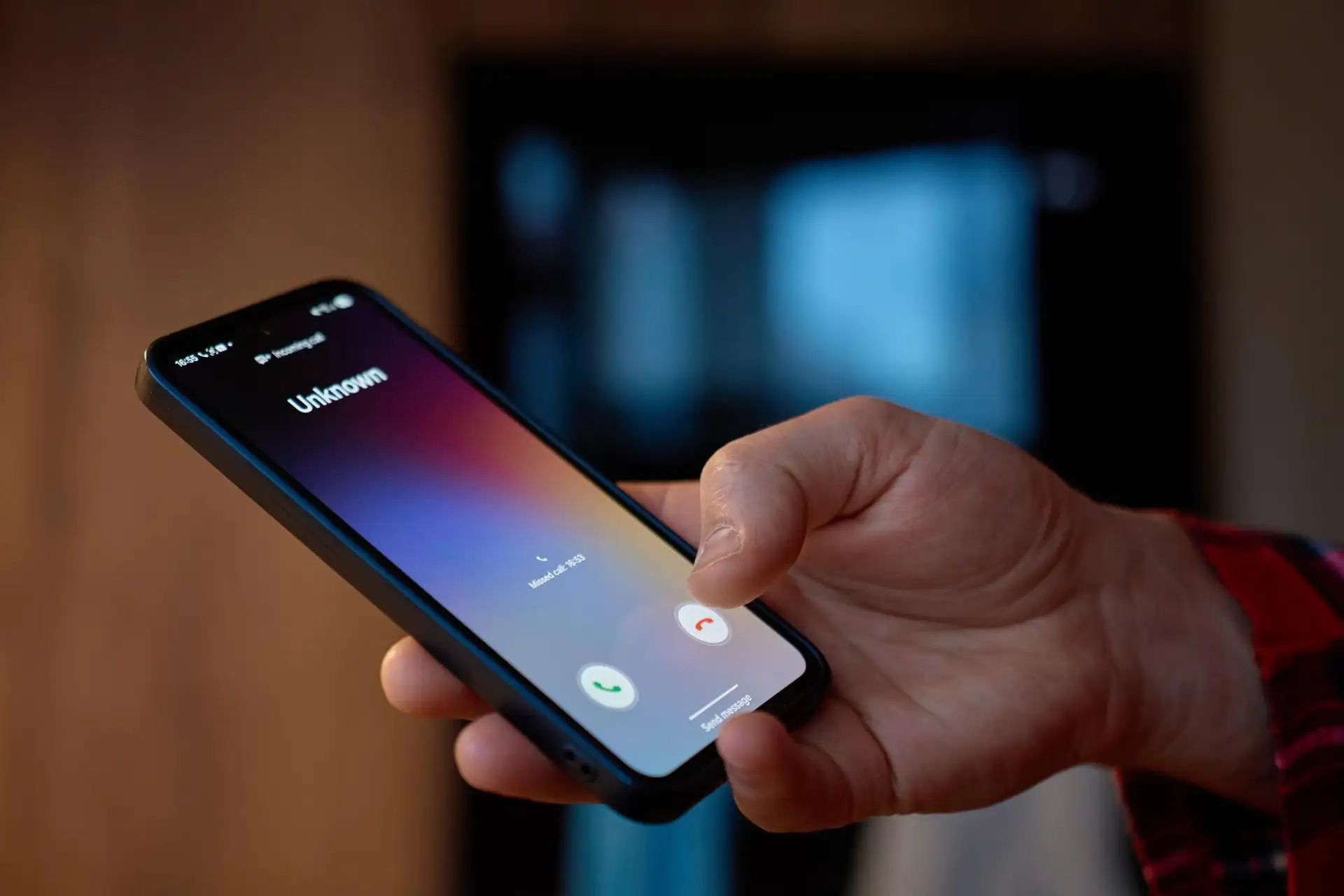
You will usually see an unfamiliar number, or no number at all. Before you hear their voice, a recorded message tells you the call is coming from a prison in England or Wales and that it is recorded. The message plays on every call, and it cannot be turned off.
Most people meet that message with no warning at all. This is what it says, how long it lasts, and what it does to the call.
What does the recorded message actually say?
The wording, as published by the Prisoners' Families Helpline, is this:
"This call is from a person currently in a prison in England/Wales. All calls are logged and recorded and may be listened to by a member of Prison staff. If you do not wish to accept this call, please hang up now."
That announcement has played on calls from prisons in England and Wales since 25 April 2022, and it plays every time. It opens "This call is from a person currently in a prison in England/Wales", then says that all calls are logged and recorded and may be listened to by a member of prison staff, and invites you to hang up if you do not wish to accept it. It runs for about 20 seconds in England and about 40 seconds in Wales, where it is repeated in Welsh. The person calling you is not charged for the call until after the message finishes playing. Call recordings are kept for a maximum of 90 days before being automatically deleted, though some are held longer where they have been monitored and are needed for prison security (Prisoners' Families Helpline, 12 April 2022, updated September 2022).
Why does it take longer if the call comes from Wales?
Because it is played twice. In Wales it is repeated in Welsh, which takes it to about 40 seconds rather than about 20.
Nothing else differs, and the table below is the whole of it.
| a prison in England | a prison in Wales | |
|---|---|---|
| what you hear | the announcement, in English | the same announcement, in English and again in Welsh |
| how long it lasts | about 20 seconds | about 40 seconds |
| who pays for it | nobody; the caller is not charged until it ends | nobody; the caller is not charged until it ends |
| can it be switched off | no, and not for one number | no, and not for one number |

Is their credit running while the message plays?
No. The source is explicit: "The person calling you will not be charged for the phone call until after the message finishes playing."
That matters, because the person paying is the person in prison, out of their own credit, by the minute. Forty seconds of Welsh would otherwise be forty seconds of a call they had paid for.
Connecting a call now takes slightly longer than it used to, and the advice from the Helpline is to stay on the line. A few seconds of silence after you answer is usually the announcement starting, not a fault.
The message costs them nothing. The minutes after it do, and the rate depends on whether they dialled a mobile or a landline.
What happens to the recording afterwards?
Recordings are kept for a maximum of 90 days and are then automatically deleted. Some are kept for longer where the call was monitored and the recording is needed for prison security.
The message exists because HMPPS has to tell everyone on the call that it is being recorded. That obligation comes from the Investigatory Powers Act 2016 and Prison Rule 35A, and the announcement was introduced on the recommendation of the Investigatory Powers Commissioner, in his December 2020 report to the Prime Minister. It is a notification requirement, not a sign that a particular call has been flagged.
The message also runs two things together. Recording is routine and applies to almost every social call; somebody actually listening is a separate decision, taken about particular people for a reason. The difference is set out in our piece on whether prison phone calls are recorded and listened to.

What if someone at home has not been told?
The message cannot be switched off for one household. In the Helpline's words: "It will not be possible to turn the service off for individual numbers."
So if someone in the house has deliberately not been told where the person is, a young child or an elderly parent, and they answer the phone, they will hear it. The suggestions given in the source are that a carer answers the phone first, or that everyone in the household is told.
If you are working out what to say, or to whom, the Prisoners' Families Helpline is free, national and run by the charity Pact: prisonersfamilies.org.
Can you ring the number back?
No. This is the part that surprises people most. PSI 49/2011 states it plainly: "The PINphone system does not accept incoming calls." Any arrangement for an incoming call has to go through an official telephone, and pre-arranged calls on office phones continue only from the Prisons and Probation Ombudsman's office, the Criminal Cases Review Commission and Cafcass (PSI 49/2011, re-issued 27 August 2026).
Calls only go one way, and only to numbers on their list, which GOV.UK says "is checked by security when they first arrive so it may take a few days before they're able to call" (GOV.UK, Staying in touch with someone in prison). Checking is not universal: HMPPS policy makes it mandatory only for named risk cohorts, and for everyone else it "is not mandatory and can therefore be considered and managed locally" (Interception, Monitoring and Security of Prisoner Communications Policy Framework, 11 August 2026).
The mechanics from the beginning, meaning the PIN account, the list and the credit, are in how the prison phone system works. If a number went on and then stopped working, that is why the prison has blocked your number.

Does a different number change what you hear?
No. It changes one thing only: the rate the call is charged at.
A forwarding service gives your household a real 01 or 02 UK geographic number, regulated by Ofcom, which forwards to a UK mainland mobile. The person in prison still has to submit it as a social contact through the prison's normal process, and the prison decides. It can refuse, and some do. Published HMPPS policy in fact directs establishments that requests to add "numbers linked to call diversion and re-routing services, must be restricted" on the grounds set out in Prison Rule 34. We would rather you read that here.
What does not change: the announcement, the recording and the monitoring all work exactly as before. Nothing about a forwarding number makes a call private.
What does change is arithmetic. In England and Wales, since 1 April 2025, a call to a UK mobile costs the person in prison 5.5p a minute on a weekday and 3.6p at the weekend, and a call to a UK landline 2.48p and 2.2p (Inside Time, 14 July 2025). By our calculation, £10 of their credit buys about 403 minutes to a landline and about 181 minutes to a mobile — a little over twice as long on the phone for the same money. Whether that is worth a subscription depends on how much they actually ring, which we work through in what a cheaper prison number actually saves.
If you doubt the difference is real, the sums are set out in full here.
Frequently asked questions
The questions families ask most often about the call itself.
Will the message tell me which prison the call is from?
No. It names the country — a prison in England or in Wales — and nothing more specific. It does not name the person calling either. If you do not yet know where someone has been taken, the official route is in how to find out which prison someone is in.
Why does the number look different each time?
The numbers prisons dial out from are not published, and nothing in policy tells you what will appear on your screen. It may show as an unfamiliar landline, or as withheld. The digits are not a reliable way to know who is calling. The announcement is.
Does the message mean somebody is listening to this call?
Not in itself. The message says calls are logged and recorded and may be listened to. GOV.UK puts it as "Prison staff can listen to and record most types of call. Some calls are not monitored". Recording is routine; listening is a decision taken separately.
Is it the same in Scotland?
Scotland introduced a similar message around seven years earlier. Beyond that, the Scottish Prison Service runs a different contract, and everything on this page — the timings, the rates, the policy references — applies to England and Wales only.
If the arithmetic works out in your favour, the plans are set out here.
The number on your screen is the part nobody can tell you in advance. The message after it is the part that never changes.